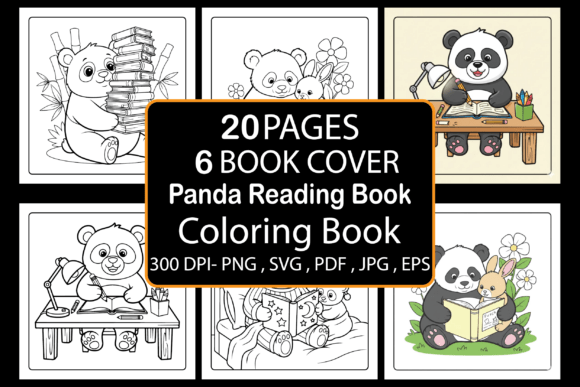
Panda Reading Book Coloring Book
First Impressions: Whimsy with Quiet Confidence
When I opened the Panda Reading Book Coloring Book, I wasn’t scanning for clipart polish—I was asking: *Does this feel like something I’d confidently stitch onto a baby’s organic cotton onesie or embroider on a linen tea towel for a boutique gift set?* The answer, after five minutes of close inspection: yes—but with nuance. These 20 designs lean into gentle storytelling: pandas curled around open books, paws holding pencils, bamboo frames, soft speech bubbles with “Read!” or “Shhh…”. No frantic linework, no aggressive outlines—just clean, confident line weight and intentional negative space. That breathing room isn’t just charming; it’s functional. It means your satin stitch won’t drown in detail, and your fill stitch will settle evenly without puckering on lightweight fabrics.
A Real Project Test: Embroidering a Nursery Pillow Cover
Last week, I used one of the Panda Reading Book Coloring Book pages—a panda sitting cross-legged with a hardcover book—as the centerpiece for a 12” x 12” linen pillow cover destined for a newborn’s nursery. I converted the coloring page into a machine embroidery design using vector tracing (not auto-trace—hand-refined curves), then built stitch paths that honored the original’s rhythm: soft satin-stitched bamboo leaves, subtle running-stitch book spines, and open areas left unembroidered to let the fabric show through. Customers notice that restraint. They don’t just say “cute”—they say “thoughtful,” “calm,” “like it belongs.” That’s the quiet strength of this collection: it doesn’t shout. It invites.
Where It Shines (and Where It Asks for Care)
The Panda Reading Book Coloring Book naturally fits projects where warmth and intentionality matter more than flash:
- Custom apparel: Works beautifully on sweatshirt cuffs, toddler tees, and relaxed-fit tote bags—especially when paired with tonal thread (heather grey on oat linen, sage green on cream canvas).
- Baby embroidery: Gentle scale and rounded forms avoid sharp corners—ideal for onesies, burp cloths, and swaddle blankets where safety and softness are non-negotiable.
- Holiday & personalized gifts: A panda holding a wrapped book? Perfect for teacher appreciation, librarian birthdays, or “new reader” milestone celebrations. Feels handmade, not mass-produced.
- Etsy & small shop product: Stands out in search results because it’s thematic—not generic. Buyers searching “literacy embroidery” or “book lover gift” land here, not on overused alphabet motifs.
But—and this is critical—it’s not plug-and-play for every surface. On stretchy jersey or thin rayon challis, those delicate book spines and tiny paw details need extra stabilizer support. On dark fabric, test contrast early: some line weights disappear unless you boost density slightly or use matte-finish thread. And avoid placing the smallest panda-in-glasses motif near a curved cap bill or deep apron pocket—it’ll distort if hooped tightly.
What It Adds to Your Finished Product (Beyond Cuteness)
This isn’t just another digital embroidery file. Used well, the Panda Reading Book Coloring Book lifts perceived value. Why? Because it reads as *curated*, not copied. When customers see that careful balance between illustration and stitchability—when they run their fingers over smooth satin-stitched bamboo stems and feel how the design breathes—they trust your craftsmanship more. That translates directly to higher price tolerance, repeat orders, and word-of-mouth referrals (“You did that panda on my daughter’s backpack? Can you do one with her name?”).
It also strengthens brand consistency—for craft businesses leaning into education, mindfulness, or slow-living themes. Pair it with hand-lettered tags, kraft packaging, and soft-toned mockups, and you’ve got cohesive storytelling from screen to shelf.
Practical Designer Notes Before You Stitch
- Always test on scrap fabric first—especially if stitching on textured weaves like bouclé or terry cloth. What looks crisp on screen may blur slightly in thread.
- Review stitch density before scaling. Some coloring-page lines translate to dense fills at large sizes—adjust if needed for breathable wearables.
- Check hoop size compatibility. The largest panda compositions sit comfortably in a 5” x 7”, but smaller variations (e.g., single paw + open book) work down to 3” x 3”—great for patches or cap fronts.
- Inspect fine details: tiny eyes, pencil tips, leaf veins. If your machine struggles with under-1mm elements, simplify them manually rather than risking skipped stitches.
- Test black-and-white mockups to gauge contrast on light vs. dark backgrounds—no surprises when printing your Etsy listing or client proof.
- Use cutaway stabilizer for knits, tear-away for stable wovens, and consider topping for nap-heavy fabrics like fleece.
- Confirm licensing terms before selling finished embroidered items commercially—or reselling the digital files. This is a Graphics asset intended for KDP, POD, and print-on-demand use, but commercial embroidery rights depend on the seller’s stated terms.
Final Thought: Not Just a Design—A Conversation Starter
I keep the Panda Reading Book Coloring Book in my go-to folder for clients who want embroidery that feels human-scaled and emotionally resonant—not decorative filler. It’s the kind of design that sparks smiles at craft fairs (“Oh! My son loves pandas *and* reading!”), earns thoughtful Instagram comments (“How did you get the book spine so crisp?”), and quietly elevates a simple kitchen towel into a meaningful heirloom piece. It doesn’t try to be everything. It does one thing—invite calm curiosity—very, very well. And in embroidery, where every stitch carries weight, that focus is rare. And valuable.