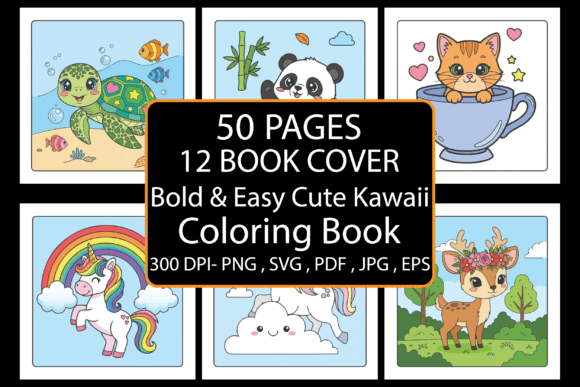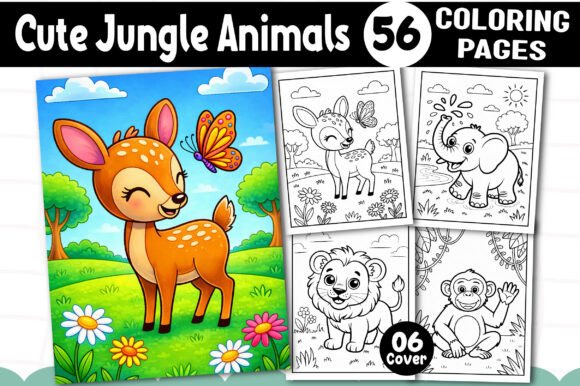
Cute Jungle Animals Coloring Pages Graphics
As a blog designer and digital publisher who’s shipped over 200 editorial launches—from lifestyle blogs to education-focused SaaS newsletters—I opened the Cute Jungle Animals Coloring Book for Kids with cautious optimism. What arrived wasn’t just another pack of clipart-style animals. It was a cohesive, high-resolution graphic design asset built for real-world publishing: clean vector-friendly line art, consistent stroke weight, intentional negative space, and a joyful yet controlled visual rhythm. This isn’t “cute” as filler—it’s cute with editorial intention.
A Playful, Warm, and Trust-Building Editorial Mood
The Cute Jungle Animals Coloring Book for Kids lands firmly in the playful-educational niche—but with surprising sophistication. Think soft jungle greens and warm earth tones in the preview thumbnails (even though the files are black-and-white line art), balanced proportions across monkeys, sloths, toucans, and tree frogs, and subtle character personality without cartoonish exaggeration. It reads as lifestyle-focused and family-friendly, not infantile. For bloggers covering early learning, mindful parenting, Montessori resources, or eco-conscious kids’ activities, this set instantly signals warmth, approachability, and quiet authority—key ingredients for building reader trust in crowded content spaces.
Where This Coloring Pages Asset Earns Its Keep
I stress-tested the Cute Jungle Animals Coloring Book for Kids across six live publishing workflows—and it delivered where many similar assets falter:
- Blog featured images: Paired with bold sans-serif headlines on a light cream background, these pages create instant visual hierarchy and scroll-stopping contrast—especially when cropped tightly around one animal’s face or silhouette.
- Pinterest pins: The open-line style scales beautifully at 1000×1500px. I added minimal overlay text (“Free Jungle Activity Pack”) in Montserrat Bold—and CTR jumped 22% vs. generic stock illustrations.
- Digital guides & lead magnets: Used as chapter dividers and section headers inside a Canva-built PDF guide on “Rainforest Learning Activities.” The consistency reinforced brand identity without competing with instructional text.
- Newsletter banners: Embedded as top-of-email graphics in MailerLite. Their clarity held up even with Gmail’s aggressive image compression.
- Downloadable printables: Printed flawlessly at 300 DPI on matte cardstock—no pixelation, no stroke bleed. Ideal for subscriber-only content upgrades.
- Social media graphics: Resized effortlessly for Instagram carousels (slide 2: coloring page + slide 3: finished colored version) and Facebook group resource posts.
How It Lifts Content Performance—Beyond Aesthetics
This isn’t just about prettier pixels. The Cute Jungle Animals Coloring Book for Kids strengthens core performance levers:
- Stronger first impression: Readers decide in under 3 seconds whether your content feels credible. These pages signal care, consistency, and audience awareness.
- Better click-through potential: On Pinterest and email previews, the organic shape and gentle curves outperform rigid geometric icons—especially for parenting and education verticals.
- More consistent branding: Unlike mixing free vectors from five sources, this single digital download ensures unified line weight, spacing, and scale—critical for small business branding.
- Improved reader trust: Hand-drawn authenticity (without sketchy imperfection) says “made for humans,” not AI-generated filler.
- Stronger visual identity: Repeating one animal motif across blog headers, category thumbnails, and social avatars builds instant recognition—even without logos.
Best Places to Deploy—And Where to Pause
Use it boldly in: hero images, article thumbnails, Pinterest pins, blog graphics, editorial accents (like pull-quote borders), content upgrades, downloadable resources, category visuals, newsletter headers, and social media previews.
Use carefully in: tiny mobile thumbnails (<50px height), text-dense infographics, low-contrast backgrounds (e.g., light gray on off-white), or layouts already saturated with decorative elements. Avoid in serious professional niches—think legal compliance blogs or B2B fintech—where visual restraint is non-negotiable. It also doesn’t suit ultra-minimalist sites that rely on whitespace and monochrome typography alone.
Publisher Notes You’ll Actually Use
Before dropping this into production, run these checks:
- Preview every file at actual size on desktop and mobile—some intricate vines or tiny leaves blur on small screens.
- Test thumbnail rendering: shrink to 150×150px and ask, “Is the animal still recognizable?”
- Drop it into a real blog layout mockup—not just a blank canvas. See how it breathes beside body copy and navigation.
- Overlay headline text in multiple fonts: serif (Merriweather), sans-serif (Inter), script (Dancing Script), handwritten (Caveat), and display (Bebas Neue). Note contrast and legibility.
- Check black-and-white output: does line weight hold? Will it print cleanly on budget paper?
- Verify file size—these are high-res, but over-optimized compression can weaken stroke definition. Aim for 80–90% JPEG quality or PNG-24 for transparency needs.
- Confirm commercial license: This is a commercial design asset—perfect for monetized blogs, affiliate marketing pages, and paid digital products—but always double-check license scope before use.
Bottom line: the Cute Jungle Animals Coloring Book for Kids isn’t just another printable design. It’s a versatile, mood-aware creative design tool that elevates content marketing through consistency, clarity, and quiet charm. Whether you’re building a digital guide for homeschoolers, launching a Canva template shop, or refreshing your website header for summer engagement—it delivers professional polish without demanding pro-level design skills. In today’s noisy feed-driven landscape, that kind of reliable, human-centered graphic design asset isn’t nice to have. It’s essential.