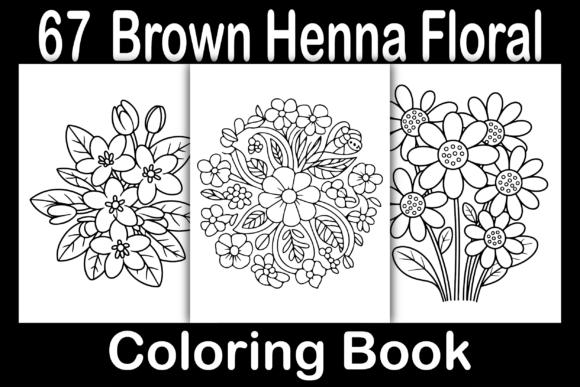
Brown Henna Floral Coloring Book
First Impressions: Warm, Organic, and Quietly Detailed
Opening Brown Henna Floral Coloring Book, I immediately notice its grounded, earthy tone—not the sharp black of typical line art, but a soft, warm brown that reads as intentional, not compromised. As an embroidery designer who’s stitched hundreds of floral motifs, I appreciate how this color choice signals something different: it’s not just a coloring page—it’s a design already thinking about texture, contrast, and tactile warmth. The 67 illustrations lean into henna’s natural language—swirling vines, layered petals, delicate stems, and subtle negative space—none overly rigid or symmetrical. That looseness translates well to stitch: it invites satin stitch curves, gentle fill stitch gradients, and running stitch accents without demanding pixel-perfect precision.
A Real-World Test: Embroidering a Linen Tea Towel for a Local Boutique
Last week, I prepped a custom batch of linen tea towels for a neighborhood kitchen boutique. Their aesthetic is “slow craft meets modern farmhouse”—so no loud graphics, no neon outlines. I pulled three designs from Brown Henna Floral Coloring Book: a medium-sized peony cluster, a trailing vine border, and a small corner motif. Printed them at 3.5", converted each to a machine embroidery design (using my standard digitizing workflow), and stitched on midweight linen with cotton thread.
The result? Calm, confident, and unmistakably handmade. The brown line weight held up beautifully in satin stitch—no jagged edges or skipped stitches—and the organic spacing between elements gave the fabric room to breathe. Customers didn’t just see “a flower.” They saw intention: the kind that makes someone pause at a craft fair table, run a finger over the raised stitch, and say, “This feels like it was made for real life.”
Where It Shines—and Where It Needs Thought
Brown Henna Floral Coloring Book excels in projects where subtlety and warmth matter most:
- Custom apparel: Works especially well on sweatshirts, relaxed-fit tees, and aprons—fabrics with gentle texture that complement, not compete with, the design’s flow.
- Personalized gifts: Baby onesies, nursery pillow covers, and holiday embroidery (think olive branch motifs on linen napkins) gain quiet elegance without looking juvenile or overly ornate.
- Small shop product: As an Etsy seller or boutique owner, these are strong design assets—you can pair one motif with neutral thread on oatmeal canvas tote bags and instantly elevate perceived value.
- Digital product previews: Because the lines are clean but not mechanical, they render beautifully in printable mockups—ideal for KDP interiors, POD book covers, or digital embroidery file listings.
Careful Use Cases: Know Before You Stitch
This isn’t a one-size-fits-all embroidery file. Its strengths also define its limits:
- Hoop size & detail density: Some motifs have fine inner linework—beautiful in print, but potentially fragile in dense fill stitch on small hoops (under 4"). Test first on scrap fabric with your intended stabilizer.
- Fabric texture & stretch: Avoid thin knits or highly stretchy fabrics unless you reinforce with cutaway stabilizer—the flowing lines rely on stable ground. On textured fabrics like terry cloth or bouclé, simplify or enlarge motifs slightly so details read clearly.
- Dark or layered surfaces: Since the original line is brown (not black), test contrast on dark fabric. A light thread may disappear; a darker thread may mute the henna warmth. Consider reversing the motif or adding a subtle underlay stitch for lift.
- Curved or tight spaces: Caps, curved pillow edges, or narrow baby bibs demand selective editing—trim trailing vines or simplify overlapping layers before digitizing.
What It Adds to Your Finished Product—Beyond Stitching
Using Brown Henna Floral Coloring Book doesn’t just fill space—it shapes perception. On a handmade product, it signals care: the kind of attention that makes customers trust your craftsmanship before they even touch the item. For a craft business, it supports brand consistency without locking you into one style—you can rotate motifs across tote bags, tea towels, and patches while maintaining a cohesive, earth-toned voice. And for personalized gifts? That warmth reads as sincerity. A monogrammed sweatshirt with a small henna-style leaf beside the name feels intimate, not generic.
It also quietly raises the bar for buyer engagement. Unlike high-contrast clipart, these designs invite closer looking—stitchers notice the rhythm of the vines, the balance of open space, the way petals curl inward. That nuance keeps people returning to your Etsy shop or boutique shelf—not just for utility, but for quiet beauty.
Practical Designer Notes Before You Digitize or Sell
Before turning any page from Brown Henna Floral Coloring Book into an embroidered patch, sweatshirt embroidery, or commercial embroidery project, do these six things:
- Test the design on scrap fabric using your exact thread colors and stabilizer—especially if stitching on baby embroidery or items meant for frequent washing.
- Check stitch density in software: avoid overloading small areas with fill stitch, which can stiffen lightweight fabrics.
- Review all tiny details—like stamen lines or leaf veins—at actual stitch size. What reads beautifully on screen may vanish under thread.
- Mock it up in black and white first to assess contrast on both light and dark backgrounds.
- Confirm licensing terms—this is a digital printable set intended for KDP interior, POD products, and book cover design. If you’re selling finished embroidered items or reselling digitized files, verify commercial use rights.
- Ask yourself: does this motif serve the product—or just fill space? With 67 options, choose intentionally. One thoughtful placement beats three crowded ones.
Final Thought: Not Just Coloring Pages—Design Assets with Quiet Confidence
Brown Henna Floral Coloring Book isn’t flashy—but then, the best embroidery design assets rarely are. They’re the ones that hold up after five washes, look intentional on a linen apron at dawn light, and make a customer feel like they’ve brought home something quietly rare. If your craft business values authenticity over algorithm-friendly noise, this set earns its place in your design assets—not as filler, but as foundation.