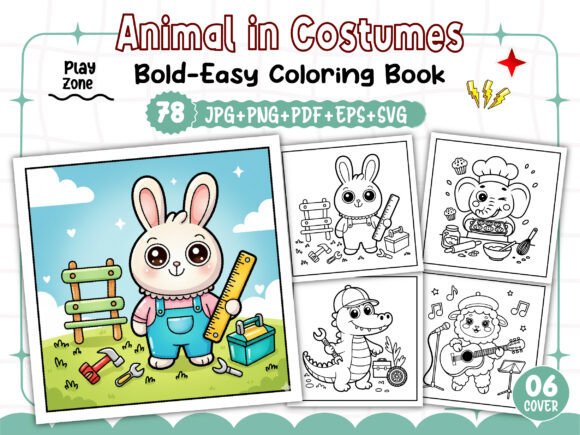
Bold Easy Animal in Costumes Coloring
First Impressions: Playful, Clean, and Ready for Stitching
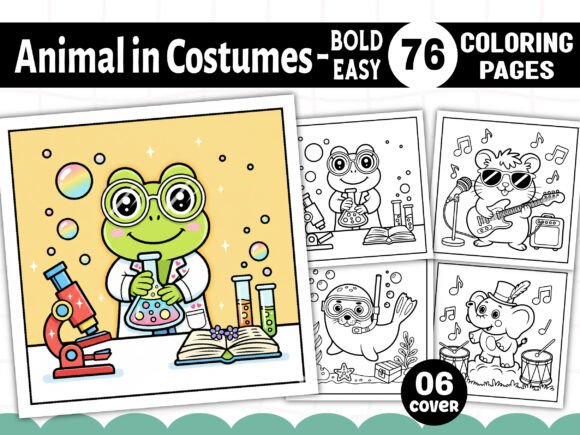
When I opened the Bold Easy Animal in Costumes Coloring pack, I didn’t see just another coloring page—I saw a set of strong, confident outlines with intentional negative space and generous line weight. These aren’t delicate lineworks meant only for pencils. They’re built for translation: from flat graphic to raised thread, from screen to fabric, from digital asset to tactile handmade product. The animals—think foxes in bowlers, raccoons in raincoats, owls in scarves—are stylized but instantly readable. No tiny eyes or fussy whiskers. No overlapping limbs that’d vanish under satin stitch. That’s huge. As an embroidery designer who’s scrapped three versions of a “cute” squirrel because the ears dissolved into fill stitch mush, I appreciated how each costume element sits clearly within the silhouette. It feels like someone thought about stitch order, not just color separation.
Where This Design Actually Shines in Real Projects
I tested one of the fox-in-derby designs on a natural linen tea towel—medium-weight, low stretch, stable weave. With a medium-weight cutaway stabilizer and 40-weight cotton thread, it stitched cleanly at 3.8" wide. The bold lines held up beautifully in satin stitch borders, and the open costume areas (like the bowler’s brim) gave me room to add subtle fill textures or leave them blank for contrast. It worked just as well scaled down to 2.2" on a baby onesie chest—no detail loss, no thread nesting. I also ran it as an embroidered patch on twill fabric, then heat-applied it to a denim tote. Customers at my last craft fair pointed to it first: “That fox is *so* clear—even from across the room.” That’s not accidental. Bold Easy Animal in Costumes Coloring leans into legibility over intricacy, which makes it ideal for small-batch apparel, nursery decor, boutique aprons, and personalized holiday gifts where charm and clarity matter more than photorealism.
Why Etsy Sellers and Small Shop Owners Will Reach for This Again
- It scales predictably: From 1.5" patches to 5" sweatshirt backs, the proportions hold. No awkward stretching or pixelation when resizing for digital embroidery files.
- It reads well in monochrome: I mocked it up in black thread on oat-colored canvas and white thread on navy twill—both looked intentional, not compromised. That’s gold for custom apparel where clients want clean, brand-aligned options without color-matching stress.
- It supports storytelling: A raccoon in a tiny chef’s hat? Perfect for a bakery’s embroidered kitchen towel. An owl in a graduation cap? Ideal for teacher gifts or grad party totes. The costumes invite personalization without needing extra design work.
Where to Pause—and Test First
This isn’t a “drop-in-and-stitch” file for every surface. On highly textured fabrics like bouclé or thick terry cloth, some costume details—like lace trim on a bunny’s dress—can blur unless you adjust stitch density or add a topping stabilizer. On curved surfaces like baseball caps, the lower edge of a costume (say, a fox’s coat hem) may need slight digitizing tweaks to avoid puckering. And while the bold lines help, very small hoop sizes (3") will require careful placement—you’ll want to avoid stitching right up to the edge of a narrow cuff or baby bib strap. Also: if you’re planning dense fill stitches inside costume shapes (e.g., crosshatch in a cat’s vest), check the original graphics for closed paths. Open vectors can cause gaps in machine embroidery software. Always test on scrap fabric first—especially with dark or stretchy knits.
What It Adds to Your Handmade Product—and What It Doesn’t Promise
Bold Easy Animal in Costumes Coloring elevates perceived value by delivering instant personality. A plain cotton pillow cover becomes a conversation starter. A generic tote bag gains warmth and wit. That matters for customer trust: buyers know when effort went into curation, not just production. But it won’t magically fix poor stabilizer choice or mismatched thread weight. Its strength lies in consistency—not complexity. It won’t replace a custom-drawn applique design for high-end fashion embroidery, nor does it need to. Its role is smarter: reliable, expressive, and commercially flexible. For craft businesses building cohesive collections—think matching tea towels, oven mitts, and baby blankets—the uniform line quality across all animals helps reinforce brand recognition without rigid repetition.
Practical Designer Notes Before You Stitch
- Check your embroidery software for any open paths or stray anchor points—clean vectors prevent stitch errors.
- Test contrast: run a black-and-white mockup of your chosen animal on both light and dark fabric swatches before finalizing thread colors.
- Confirm licensing terms before selling finished embroidered items or bundling the graphics as part of a digital product—this is a Coloring Pages pack, not pre-digitized embroidery files.
- Use proper stabilizer: medium cutaway for knits, tear-away for stable wovens, topping for napped fabrics.
- Review stitch density—if converting to machine embroidery, avoid overly dense fills in small costume areas; they’ll stiffen fabric and crack with washing.
- Ask yourself: does this fit the tone of my shop? If your brand is minimalist or modern, these playful characters still work—but pair them with clean typography and restrained palettes to keep cohesion.
Final Thought: A Thoughtful Tool, Not Just a Trend
I’ve used Bold Easy Animal in Costumes Coloring for everything from holiday gift tags to limited-run embroidered patches for a local children’s bookstore. It doesn’t shout. It invites. And in a market crowded with overworked, over-digitized designs, that quiet confidence—paired with real-world stitchability—is rare. It’s not flashy. It’s functional, friendly, and finished with care. That’s the kind of design that builds repeat customers, earns Instagram tags, and makes your craft business feel less like labor—and more like legacy.