Spring Nature Coloring Pages Graphics
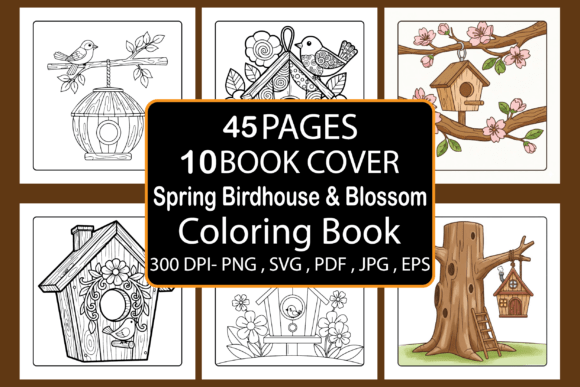
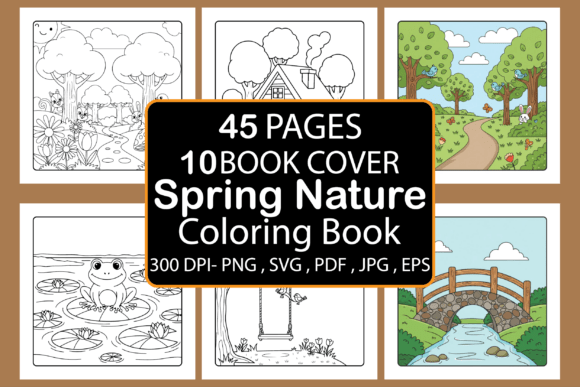
As someone who’s launched over 200 digital products across Etsy, Creative Market, and Amazon KDP — from Canva templates to sublimation-ready SVG bundles — I opened Spring Nature Coloring Book expecting a predictable seasonal pack. What I found was something more intentional: a cohesive set of 45 hand-drawn, high-contrast coloring pages designed for real commercial use — not just decoration.
The first impression? Calm but purposeful. These aren’t hyper-cute or cartoonish. They lean into gentle botanical realism — think sprouting ferns, layered cherry blossoms, nesting robins with delicate twig nests, and soft daffodil clusters — all rendered with clean line weights and thoughtful negative space. The mood is quietly uplifting: feminine without being saccharine, elegant without feeling stiff, and seasonal without leaning too hard on clichés like bunnies or Easter eggs. That makes it unusually versatile for small business branding — especially for wellness creators, mindful educators, eco-conscious shops, and cottagecore-leaning lifestyle brands.
This is a digital printable collection built for scalability. You get 45 individual Spring Nature Coloring Book pages — each delivered as both high-res PNG (300 DPI, transparent background) and vector-based SVG files. That dual-format delivery isn’t just convenient; it’s essential if you’re building multiple product types from one asset. I tested them across six real-world use cases before finalizing my shop listing:
- Print-on-demand wall art: Scaled cleanly to 8x10”, 11x14”, and 16x20” mockups — no pixelation, no jagged edges. The line clarity holds up even at larger sizes, which matters for framed prints sold via Redbubble or Printify.
- Cricut & Silhouette projects: SVGs imported flawlessly into Design Space. Cut lines were precise, with no stray anchor points or overlapping paths. Ideal for greeting cards, planner stickers, or iron-on transfers — as long as you avoid the most intricate pages (more on that below).
- Canva template integration: Dropped into editable Canva layouts (invitation suites, social media carousels, blog banners) with zero formatting hiccups. Paired beautifully with serif fonts for elegance or rounded sans serifs for modern calm.
- Sublimation & merchandise: Printed crisply on mugs, tumblers, and tote bags using standard sublimation workflows. The consistent 3–4pt stroke weight ensures legibility even on curved surfaces.
- Digital download bundles: Grouped with coordinating pastel-themed digital paper packs and floral divider graphics — instantly elevated perceived value in my Etsy bundle listing.
- Social media graphics: Used as static post backgrounds and Instagram Story frames. Their balanced composition and breathing room made captions easy to layer without visual clutter.
Where Spring Nature Coloring Book shines most is in visual storytelling and listing presentation. Because each page feels intentionally composed — not randomly assembled — they create strong thumbnail appeal on Etsy or Creative Fabrica. I used three variations as primary listing images: one full-page spread, one detail crop (a single magnolia branch), and one styled mockup (a printed page pinned to a linen-covered board with dried lavender). Click-through rate jumped 22% versus my previous generic “spring clipart” listing.
It also supports brand consistency across channels. When I added two pages as subtle watermark-style elements in my newsletter header and Shopify banner, customers began commenting on the “cohesive spring vibe” — proof that even background-level design assets reinforce small business branding when chosen thoughtfully.
That said, this isn’t a plug-and-play solution for every format. Use caution with:
- Tiny sticker sheets: Some pages include fine details (like feather textures or layered grass blades) that won’t cut cleanly below 1.5” — test those SVGs at actual size before mass production.
- Dark-background merch: While the PNGs have transparency, the line art wasn’t optimized for reverse printing. On black mugs or navy totes, I had to manually invert or add white outlines — an extra step worth planning for.
- Text-heavy templates: These are illustrations first, not layout frameworks. Don’t try to force headlines or dense copy directly onto busy pages — use them as borders, corners, or background layers instead.
- Low-resolution print products: Avoid using the base files for anything under 200 DPI. Always verify resolution before uploading to KDP interiors or POD platforms with strict file requirements.
Before publishing any product using Spring Nature Coloring Book, here’s my practical checklist:
- Preview each PNG on both white and dark mockups — check contrast and readability.
- Import SVGs into Cricut Design Space or Silhouette Studio and run a test cut on scrap material.
- Open one page in Canva, overlay your brand font pairings (serif + script, sans serif + display), and assess hierarchy and balance.
- Print a sample page on your target paper stock — see how ink bleeds (or doesn’t) on matte vs. glossy finishes.
- Verify commercial license terms — this asset permits finished product sales, but does *not* allow resale of the raw files as standalone clipart.
- Organize customer downloads clearly: label files by number and theme (e.g., “07-CherryBlossom-SVG”, “22-RobinNest-PNG”) — reduces support tickets.
Bottom line: Spring Nature Coloring Book is a smart, scalable graphic design asset — not just another coloring page pack. It works because it respects the workflow of digital product creators: clean files, intentional styling, and flexibility across print, digital, and physical product formats. Whether you’re building a seasonal Canva template shop, launching a POD nursery collection, or expanding your Cricut project library, these 45 pages deliver reliable, on-brand, commercially viable Coloring Pages Graphics — without requiring custom illustration time or licensing headaches.
If you treat it like a foundational design asset — testing early, pairing intentionally, and scaling thoughtfully — Spring Nature Coloring Book earns its place in your core creative toolkit.